

Press Release - June 1, 2025 - Yapı İnşaat Magazine
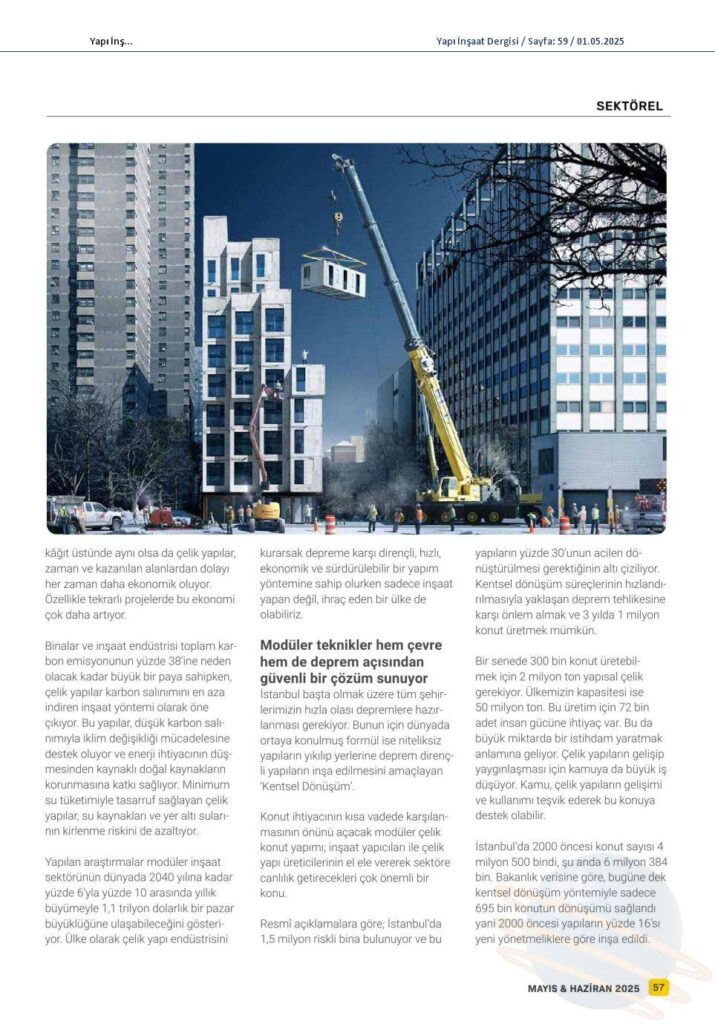
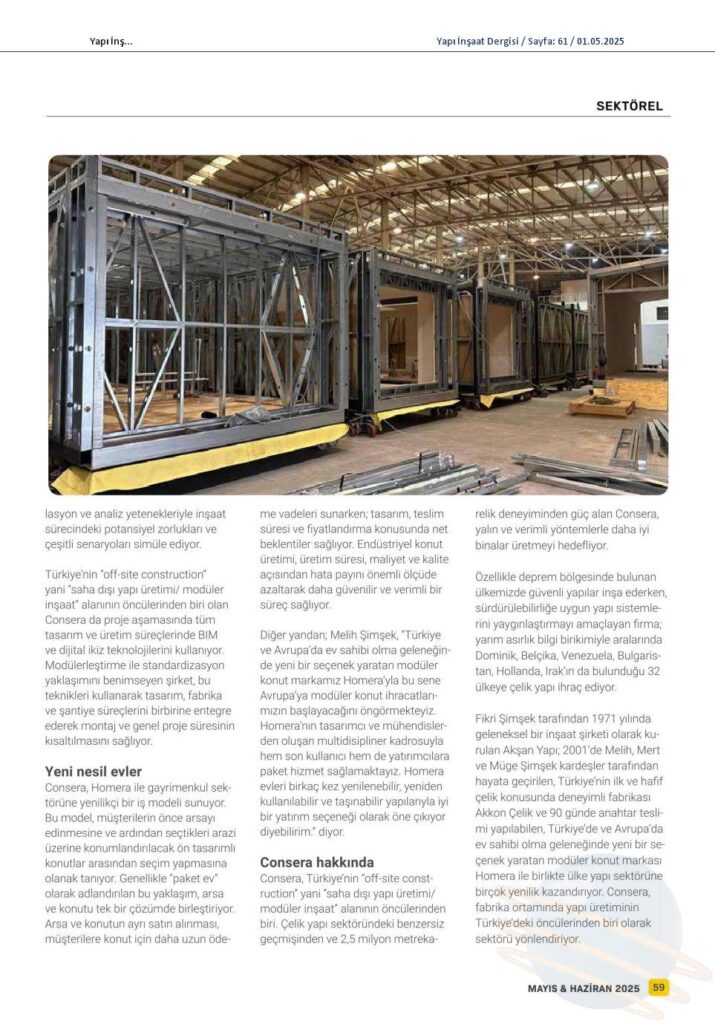
Unlike traditional methods, modular construction involves the production of 2D or 3D modules in factories and assembling them on site. This method speeds up the construction process and reduces the need for labor. By carrying out the planning, design and assembly phases of construction simultaneously, modular techniques shorten the process by up to 40 percent compared to traditional methods.
Industrial and modular building systems offer many advantages. Thanks to these systems; unexpected cost increases are prevented, as well as delays and surprise expenses caused by adverse conditions such as climate due to the fact that most of the work is carried out in the factory. In addition, since these types of structures are 4.5 times lighter than traditional construction, they take less earthquake load and are exposed to 4 times less earthquake force than structures built with traditional methods.
"Off-site construction", where production is carried out in the factory and assembled on site, eliminates the human errors that can be encountered in on-site construction. With this method, both work and cost are more controlled in construction.
As in the rest of the world, worker and craftsman constraints have started to constitute a major obstacle in our construction in our country. It is not possible to work in shifts under all conditions on the construction site, whereas modular structures can be produced 24/7 in a factory environment.
One of the most positive contributions of modular structures to building physics is energy efficiency. With this technique, it is much more possible and economical to build energy-efficient structures. Although the costs of steel and traditional structures are the same on paper, steel structures are always more economical due to the time and space saved. Especially in repetitive projects, this economy increases much more.
While buildings and the construction industry account for 38 percent of total carbon emissions, steel structures stand out as the construction method that minimizes carbon emissions. These structures support the fight against climate change with low carbon emissions and contribute to the conservation of natural resources due to reduced energy demand. Steel structures, which provide savings with minimum water consumption, also reduce the risk of contamination of water resources and groundwater.
Research shows that the modular construction industry could reach a market size of 1.1 trillion dollars by 2040 with an annual growth rate between 6 percent and 10 percent. As a country, we are developing the steel construction industry
If we establish an earthquake-resistant, fast, economical and sustainable construction method, we can become a country that not only builds but also exports.
Modular techniques offer an environmentally and earthquake safe solution
All our cities, especially Istanbul, need to be prepared for possible earthquakes. The formula put forward for this in the world is 'Urban Transformation', which aims to demolish unqualified buildings and build earthquake-resistant structures in their place.
Modular steel housing construction, which will pave the way for meeting the housing need in the short term, is a very important issue that will bring vitality to the sector by building constructors and steel structure manufacturers working hand in hand.
According to official statements, there are 1.5 million risky buildings in Istanbul, and these
It is underlined that 30 percent of the buildings need to be urgently transformed. By accelerating urban transformation processes, it is possible to take measures against the impending earthquake danger and to produce 1 million houses in 3 years.
In order to produce 300 thousand houses in a year, 2 million tons of structural steel is required. The capacity of our country is 50 million tons. For this production, 72 thousand manpower is needed. This means creating a large amount of employment. The public sector also has a big role to play in the development and widespread use of steel structures. The public can support this issue by encouraging the development and use of steel structures.
The number of houses in Istanbul before 2000 was 4 million 500 thousand, now it is 6 million 384 thousand. According to the ministry data, only 695 thousand houses have been transformed through urban transformation, meaning that 16 percent of the pre-2000 buildings were built according to the new regulations.
Assuming that all post-2000 buildings are earthquake-resistant, there are still a high number of earthquake-prone houses in Istanbul.
According to the World Steel Association (WSA), Turkey will be the seventh largest steel producer in the world and the first largest in Europe in 2020. Unfortunately, this volume has not been reflected in the steel structures built in our country so far. We see that the use of steel in industrial buildings in Turkey has increased from 1 percent to 5 percent in 20 years. However, unfortunately, there has not been a sufficient increase in this regard for residences. In the past period, the ratio of steel structures to total buildings reached 1.5 percent with an increase of approximately 0.5 percent in residential buildings.
Approximately 50 percent of the buildings in the US and the UK, 30 percent in Germany and France, and more than 50 percent in Iran are built with steel structural systems.
Consera's modular construction solutions
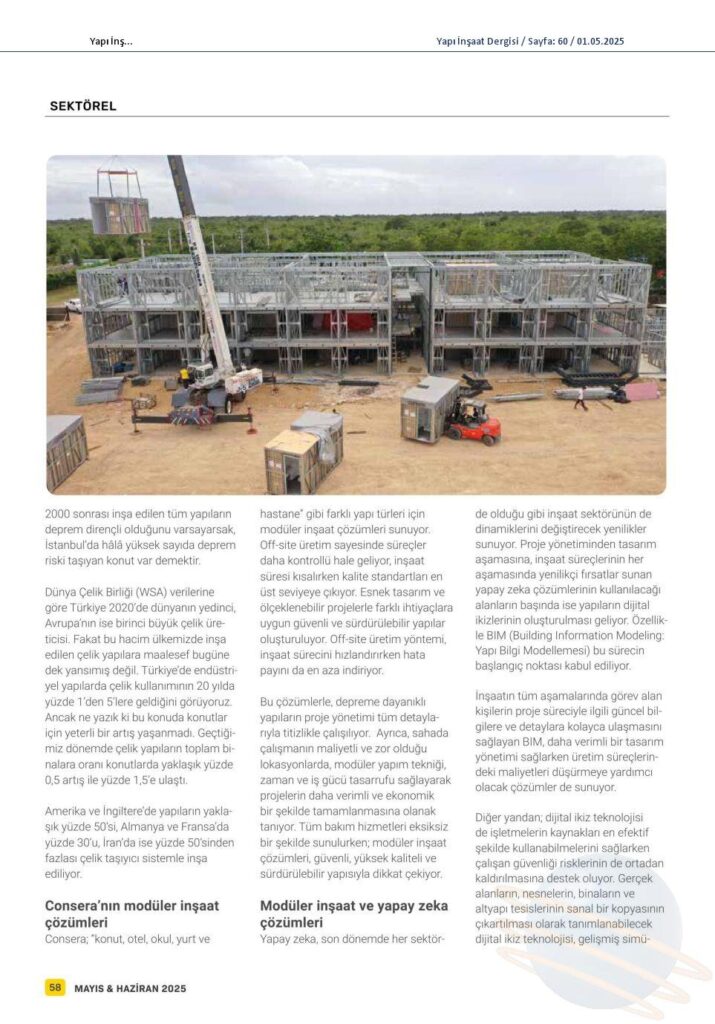
Consera offers modular construction solutions for different types of buildings such as residences, hotels, schools, dormitories and hospitals. Thanks to off-site production, processes are more controlled, construction time is shortened and quality standards are maximized. With flexible design and scalable projects, safe and sustainable structures suitable for different needs are created. The off-site production method speeds up the construction process while minimizing the margin of error.
With these solutions, project management of earthquake-resistant buildings is meticulously worked out in every detail. In addition, in locations where on-site work is costly and difficult, the modular construction technique saves time and labor, allowing projects to be completed more efficiently and economically. While all maintenance services are provided in full, modular construction solutions stand out with their safe, high quality and sustainable structure.
Modular construction and artificial intelligence solutions
Artificial intelligence offers innovations that will change the dynamics of the construction industry as in every sector. One of the leading areas where artificial intelligence solutions, which offer innovative opportunities at every stage of construction processes, from project management to design, will be used is the creation of digital twins of buildings. Especially BIM (Building Information Modeling) is considered the starting point of this process.
BIM, which enables people involved in all stages of construction to easily access up-to-date information and details about the project process, provides a more efficient design management and offers solutions to help reduce costs in production processes.
On the other hand, digital twin technology enables businesses to utilize resources in the most effective way, while helping to eliminate employee safety risks. Digital twin technology, which can be defined as making a virtual copy of real areas, objects, buildings and infrastructure facilities, simulates potential challenges and various scenarios in the construction process with advanced simulation and analysis capabilities.
Consera, one of the pioneers of "off-site construction" in Turkey, uses BIM and digital twin technologies in all design and production processes during the project phase. Adopting a standardization approach with modularization, the company uses these techniques to integrate design, factory and construction site processes to shorten assembly and overall project time.
New generation homes
Consera is introducing an innovative business model to the real estate sector with Homera. This model allows customers to first acquire the land and then choose from a selection of pre-designed homes to be located on the land of their choice. Often referred to as a "package house", this approach combines land and housing into a single solution. Buying land and housing separately offers customers longer payment terms for housing, while providing clear expectations on design, delivery time and pricing. Industrial housing production provides a more reliable and efficient process, significantly reducing the margin for error in terms of production time, cost and quality.
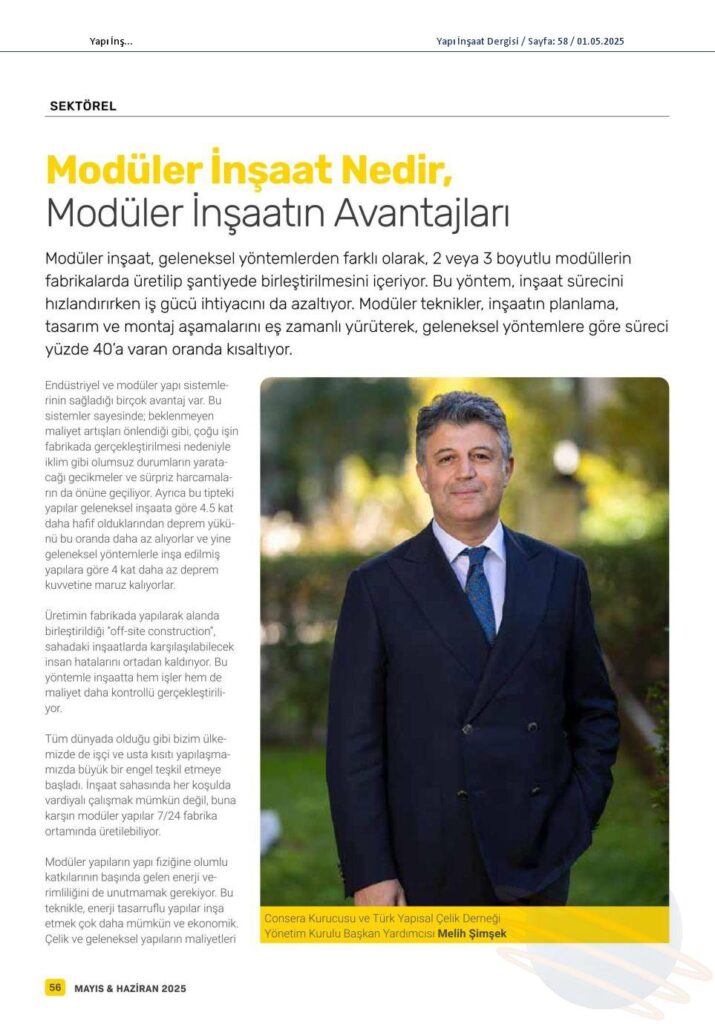
On the other hand, Melih Şimşek said, "We anticipate that our modular housing exports to Europe will start this year with our modular housing brand Homera, which creates a new option in the tradition of home ownership in Turkey and Europe. With Homera's multidisciplinary team of designers and engineers, we provide package services to both end users and investors. I can say that Homera houses stand out as a good investment option with their renewable, reusable and portable structures."