


Sustainable construction is not an option, it is a necessity!
The way to achieve this is through structural and modular steel structures
Climate crisis, drought, risk of famine, floods... Sustainability has become one of the most important agenda items for all segments of society, from governments to companies all over the world. In Turkey, unfortunately, the gravity of the situation is only now being realized. Especially in sectors such as construction, where 38 percent of carbon emissions are caused by construction, yet the conservative perception cannot be overcome. This carbon emission rate will increase even more if the large amount of building needs created by the requirements and urban transformation, which must be realized urgently due to the earthquake hazard, are met with traditional methods. But a sustainable construction system is possible! According to research, structural or modular steel is the way to do this. Moreover, considering that Turkey is the world's eighth largest steel producer, the only thing left to achieve this system is a change in habits and public support.
According to the International Federation of Red Cross and Red Crescent Societies' World Disaster Report 2020, 83 percent of all disasters triggered by natural hazards in the last 10 years were caused by severe weather and climate-related events such as floods, storms and heat waves. More than 410,000 people lost their lives due to weather and climate-related disasters. According to the 2020 Global State of Building and Construction Report of the Global Alliance for Buildings and Construction (GlobalABC), one of the biggest drivers of global warming is carbon emissions from new construction and energy consumption of buildings. Buildings and the construction industry account for 38 percent of all carbon emissions. In addition, the construction industry accounts for 36 percent of the world's energy use. Therefore, in this century, where the world's resources are rapidly consumed and continue to be consumed; the establishment of building industries that are compatible with sustainability principles has become a necessity rather than an option for the protection of the rights of future generations.
Minimum energy requirement, 100 percent recycling
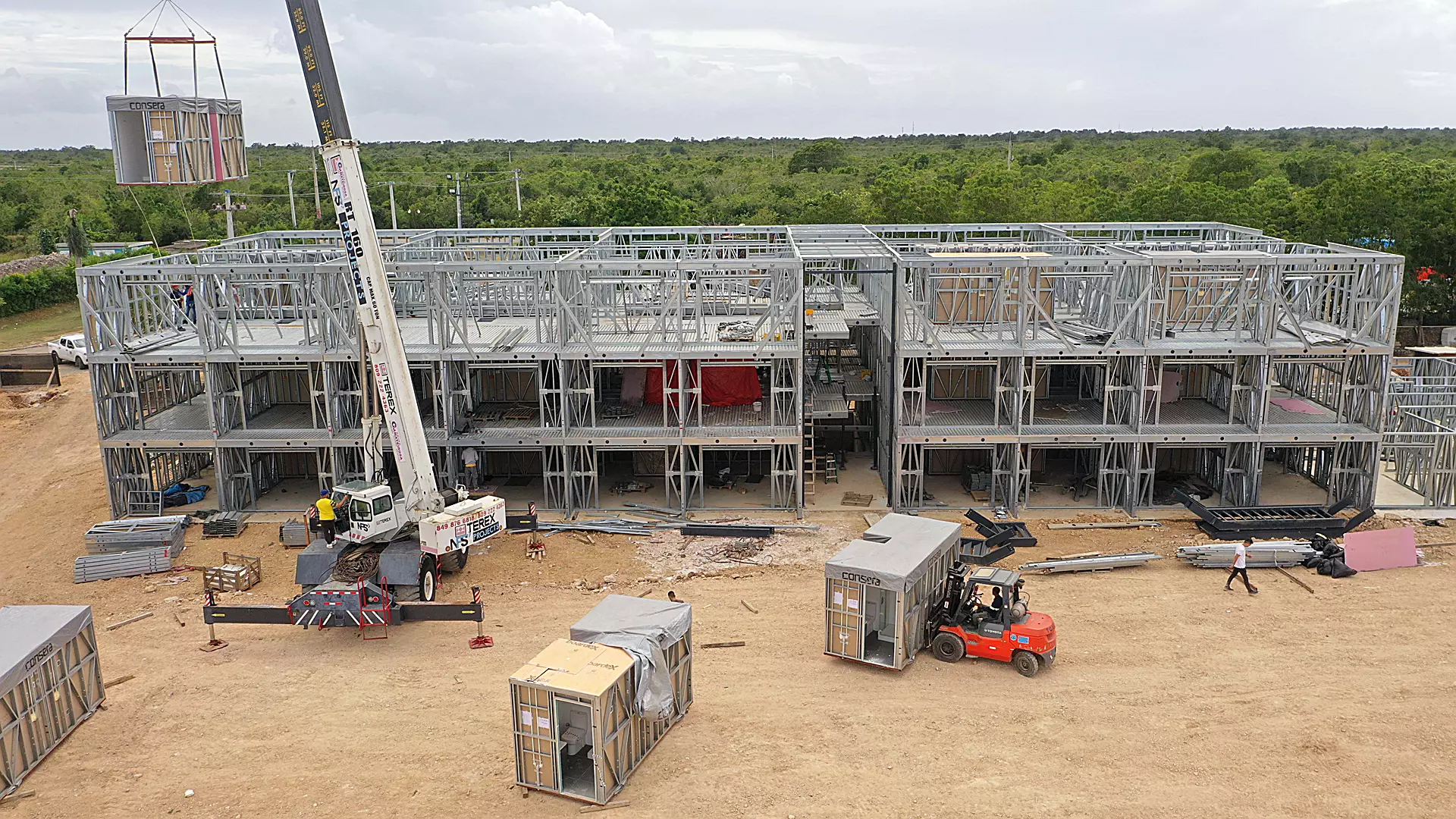
Research shows that steel is the best sustainable construction material to contribute to climate action. Steel can be recycled up to 100 percent without loss of performance. In addition, steel structures built with pre-engineered building systems can be completed with minimum energy requirements. Thus, while reducing foreign dependence on energy, it contributes to the reduction of carbon emissions. Likewise, modular steel structures do not create a construction waste problem as they are produced in the factory. Modular units can be dismantled, transported and reused. They also offer an environmentally friendly option by reducing material waste as they are prepared in accordance with the project in the factory. Since they do not require large construction areas like traditional construction methods, they cause less damage to the environment and reduce noise pollution as they can be quickly assembled on site.
Construction has become an industrial product in the world
With sustainability gaining importance, the demand for steel structures has increased in the world. Approximately 50 percent of buildings in the US and the UK, 30 percent in Germany and France, and more than 50 percent in Iran are built with steel structural systems. In particular, the "off-site construction" method, in which maximum work is done in the factory and completed on site, stands out with its sustainability. Toyota established Toyota House with its "just in time" approach, Ikea and Skanska launched Boklok, and Tesla started modular house production with Boxable. Unfortunately, construction in Turkey is still seen as conservative. According to TOBB's research titled "Steel Construction Sector in Search of a New Market", between 1 and 1.5 percent of the houses in Turkey are made of structural steel structures. However, in addition to sustainability, steel structures are 7-10 times lighter than traditional structures and are therefore less exposed to earthquake forces. Since they are produced in an industrial environment with 100 percent supervision, they are much more reliable against human errors. They are produced 2-3 times faster than traditional methods. In modular steel structures, this speed provides time advantages of up to 100 percent.
"Five scrap cars are worth a house"
Consera, one of Turkey's pioneering companies in structural and modular steel structures, and Homera, one of Turkey's first industrial housing brands that delivers ready-made houses with the "From Factory to People" approach, are working to popularize building systems that are suitable for sustainability in the country. Melih Şimşek, Founder of Consera and Vice Chairman of the Board of Directors of the Turkish Structural Steel Association, states that they have been working to popularize structural and modular steel structures in Turkey for 25 years, drawing strength from their experience of 2.5 million square meters:
"There are millions of housing needs in our country and this number is increasing every year. At this point, if the need is to be met with traditional methods, we can make important mistakes in terms of sustainability. To ensure transformation, we need to focus on climate change and other sustainability issues as well as the earthquake problem. Steel structures can be used again and again because they are recyclable. For example, in the Maraş earthquake, hundreds of thousands of buildings collapsed and the rubble of these structures took up a huge amount of space in nature. There is an expression I often hear in America: 'Five automobile scraps are worth one house. It is a discourse that emphasizes how valuable recycling of building materials is. However, steel structures cannot become widespread in Turkey due to prejudices, lack of knowledge and consumption habits. However, Turkey ranks eighth in the world in steel production. Therefore, the only thing necessary for steel structures to become widespread is a change in habits and public support. For us, construction is first and foremost a 'human' and 'national' issue. We do not look at our work as a 'business' whose only goal is to make a profit, we aim to design places where people can live safely and to spread a sustainable construction and building production system throughout the country."

